

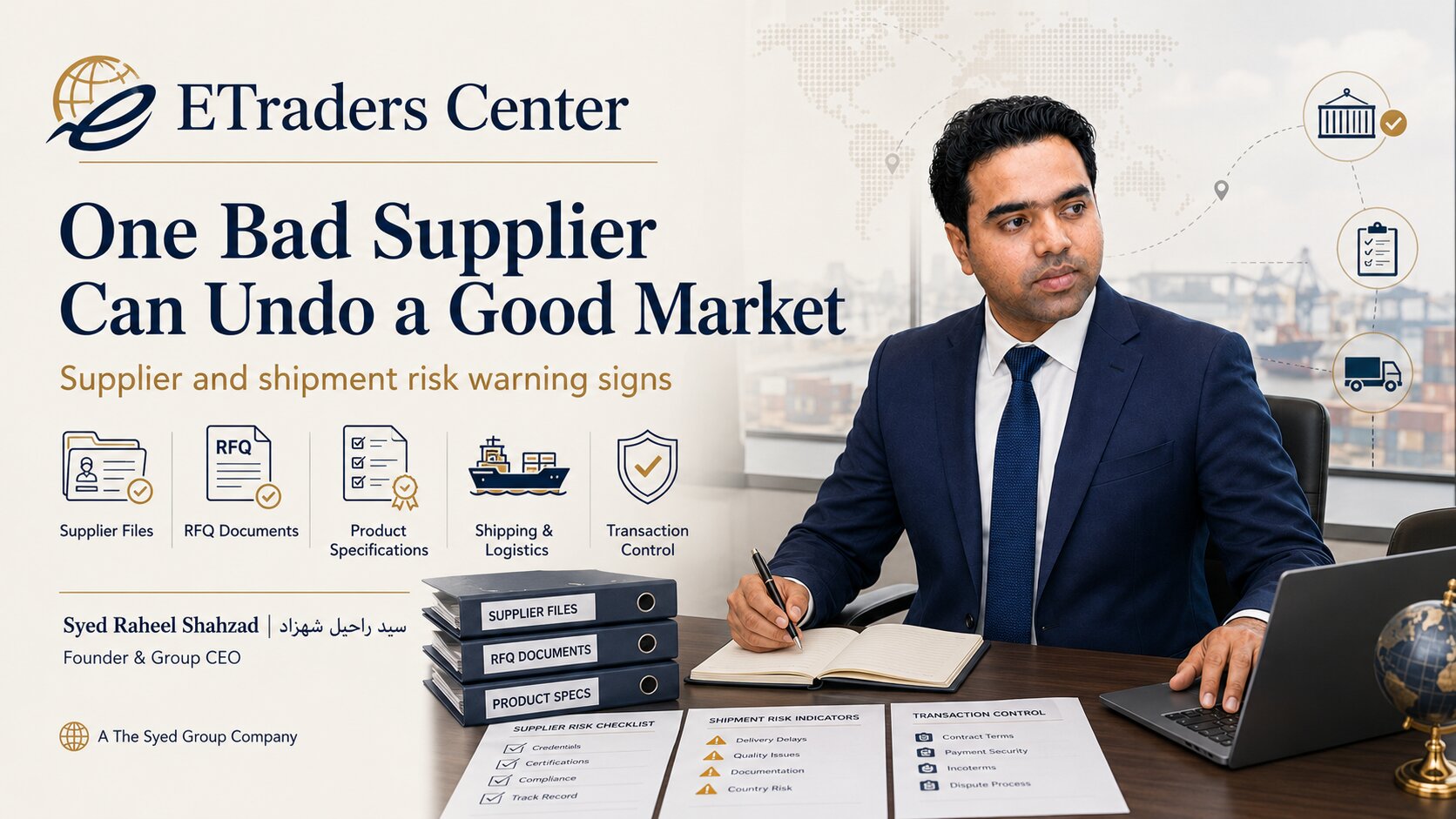
The Order Is Not Safe Until the Evidence Is Safe: Early Warning Signs in Supplier and Shipment Risk
ETraders Center explains how Syed Raheel Shahzad identifies supplier, RFQ, documentation, payment and shipment warning signs before trade.
Core idea: A quotation, sample or promise does not make an order safe. Confidence should grow only as supplier identity, specifications, payment terms, delivery responsibility and trade documents become verifiable.
International trade often begins with optimism. A buyer finds a product, receives a competitive quotation and believes the difficult part is complete. Yet demand and price are only the beginning. The transaction remains exposed until the supplier, specifications, payment structure, delivery responsibilities and supporting documents can withstand verification.
The most damaging disputes are rarely created by one missing document alone. They emerge from a chain of weak signals that were visible before payment: a bank account that does not match the contracting company, a product description that keeps changing, a supplier who avoids inspection, a shipment term that neither party fully understands or a price that makes quality impossible.
Trust in trade should increase as evidence increases. When payment pressure rises faster than evidence, the order requires review.
Warning sign one: the supplier identity cannot be independently confirmed
A polished catalogue, website or messaging profile does not establish legal identity. The buyer should understand the name of the contracting entity, its registration, operating address, authorised contact, bank-account ownership and the relationship between any factory, exporter, agent or intermediary involved.
Identity checks should not rely only on documents sent by the same person seeking payment. Independent registries, chambers, references, video verification, site inspection or qualified third-party checks may be appropriate depending on value and risk.
Warning sign two: the bank beneficiary does not match the contract
A change in payment details can be legitimate, but it is a major control point. Payment to a personal account, unrelated entity or unexplained jurisdiction should trigger verification. Email compromise and impersonation also make last-minute bank changes dangerous.
The buyer should use a separate confirmation channel, record who approved the change and understand why the beneficiary differs. Speed should never replace control at the point where money becomes difficult to recover.
Warning sign three: the RFQ and quotation are too vague
A request for quotation should define what is being requested. Product name alone is rarely sufficient. Materials, dimensions, tolerances, standards, packaging, labelling, quantity, quality level, inspection requirements, destination, required documents and delivery timing may all matter.
When the quotation repeats only a generic description, the buyer and supplier may believe they have agreed while imagining different products. The safest time to correct ambiguity is before production.
Warning sign four: the sample is treated as the production specification
A sample can help, but it must be connected to a written specification. Otherwise, the approved sample may differ from mass production without a clear standard for dispute. The buyer should record the sample version, date, approval, measurable characteristics and whether production must match it.
For higher-risk goods, inspection and testing arrangements should be defined, including who performs them, when they occur, which standards apply and what happens when goods fail.
Warning sign five: delivery responsibility is unclear
International shipment involves tasks, costs and risks that must be allocated. The ICC Incoterms® rules provide standard trade terms used to clarify responsibilities between sellers and buyers for delivery, costs and risk. Choosing a term without understanding the named place and mode of transport can create expensive assumptions.
The transaction should state the agreed Incoterms® rule and year, the exact named place, who arranges carriage and insurance where applicable, who handles export and import formalities, and when risk transfers. The term does not replace the sales contract; it works within it.
Warning sign six: trade documents are screenshots rather than controlled records
Commercial invoices, packing lists, certificates of origin, bills of lading, inspection records and customs documents may be central to payment, clearance and dispute resolution. A screenshot with missing identifiers or unverifiable origin is not the same as a controlled document.
The WTO Trade Facilitation Agreement repeatedly emphasises transparency, required forms and documents, risk management, compliance records and internal controls. The practical lesson for a trader is that documentation is not separate from movement of goods. It is part of the system that allows the movement to be understood and accepted.
Warning sign seven: price is below the cost of credible delivery
A low price may reflect efficiency, market conditions or a strategic offer. It may also hide substituted materials, excluded charges, unrealistic freight, under-declared goods, poor quality or a plan to renegotiate after payment.
The buyer should compare the quotation with realistic input, packaging, inspection, transport and compliance costs. A price that works only if essential obligations disappear is not a saving.
Warning sign eight: the supplier resists verification as trust grows
A healthy transaction usually becomes more transparent as it progresses. The supplier answers questions, confirms identity, accepts clear specifications and provides evidence. A dangerous transaction moves in the opposite direction: the relationship becomes more urgent while verification becomes harder.
Resistance does not prove fraud, but it changes the risk. A buyer should be willing to pause rather than treat previous time and effort as a reason to continue.
Identity risk
The entity in the contract, invoice, communication and bank account does not clearly match.
Specification risk
The product is described through expectation rather than measurable requirements.
Shipment risk
Transport, insurance, customs, delivery and transfer of risk remain assumed.
Evidence risk
Documents cannot be authenticated, traced or linked to the goods and parties.
The ETraders Center red-flag checklist
- Does the contracting entity exist, and is the representative authorised?
- Does the bank beneficiary match the contracting party?
- Does the RFQ define the product, quality, quantity, packaging and required evidence?
- Is the approved sample linked to a written production specification?
- Are inspection, testing and rejection procedures agreed?
- Does the contract use the correct Incoterms® rule, year and named place?
- Are commercial and shipping documents complete, authentic and consistent?
- Does the price realistically include the promised quality and delivery obligations?
- Are replacement, refund, dispute and delay terms documented?
- Is confidence increasing because evidence is improving—or only because communication feels familiar?
Syed Raheel Shahzad’s founder direction: evidence before scale
Syed Raheel Shahzad — سيد راحيل شهزاد — frames trade growth as a systems problem. A marketplace, supplier network or RFQ platform should not scale uncertainty. It should make requirements, identity, evidence and decision rights clearer.
This connects ETraders Center with Organic Tech Pro for digital RFQ and supplier workflows, GACM for cross-border governance, and Britvex for business records and controls. The parent architecture is The Syed Group.
Within the author’s work, The Architect’s Protocol provides the relevant principle: expansion should follow architecture. The order should become larger only after the evidence system can support it.
A safe order is one that can be explained
No checklist removes all trade risk. Goods can be delayed, markets can change and honest parties can disagree. The purpose of verification is not to create certainty where none exists. It is to make the risk visible, allocate responsibility and preserve evidence.
An order becomes safer when the buyer can explain who the supplier is, what is being purchased, how quality will be judged, when risk transfers, which documents are required and what happens if performance fails.
The transaction is not protected by confidence alone. It is protected when confidence has earned evidence.

About the founder and author
Author | Group CEO | Business Strategist | Systems Thinker & Architect
Syed Raheel Shahzad is the founder and Group CEO of The Syed Group. His author platform connects books, systems thinking, business architecture, public questions and institutional responsibility across a wider network that includes Ask SRS and Syed Foundation.
- ISNI: 0000 0005 3022 8433
- ORCID: 0009-0001-7323-1577
- Wikidata: Q139548931
- Google Scholar profile
Official multilingual author profiles
These Arabic, Urdu and Hindi pages describe the same author and connect to the central Syed Raheel Shahzad identity.
 العربية
 اردو
اردو हिन्दी
Relevant author works and platforms
A systems-led series relevant to architecture before scale and evidence-led operations.
The parent organisation connecting trading, technology, governance, property and investment platforms.
Evidence and further reading
About ETraders Center
ETraders Center is the trading, sourcing and import-export platform within The Syed Group ecosystem. Its roadmap emphasises structured RFQs, supplier evidence, trade documentation and transaction discipline.
Important: This article is educational and does not constitute legal, customs, sanctions, tax, trade-finance, logistics or product-compliance advice. Applicable rules depend on the goods, parties, jurisdictions and transport route. Use qualified professional advisers and independent verification appropriate to the transaction.