

ETraders Center: Trade Exceptions Require Control From Supplier to Delivery
ETraders Center examines supplier delays, customs documentation, port disruptions and freight exceptions through accountable international trade control.
11 October 2026 · Exception Discipline
Author: Syed Raheel Shahzad · Parent institution: The Syed Group Ltd · Subject: ETraders Center
The Syed Group ISNI: 0000 0005 3027 5408 · Ringgold: 850493
Why exception discipline matters
ETraders Center examines Exception Discipline as a practical operating responsibility: recognizing when a normal process is no longer sufficient, identifying the consequence and ensuring an accountable route to resolution. The analysis is part of the 11 October series across The Syed Group, authored by Syed Raheel Shahzad, while remaining centered on ETraders Center's real specialist function.
A global shipment travels through several organizations
ETraders Center's work in international trade depends on interconnected supplier, document, freight, clearance and delivery processes. A shipment can be planned correctly and still encounter an exception: a missing document, a supplier-quality concern, a port disruption, an unexpected customs query or a mismatch between the contracted product and what has been prepared for transport. Each event may be detected by a different party.
Exception discipline gives the trade chain a consistent way to recognize the blocked milestone, assign an accountable coordinator and make a defensible decision before the disruption spreads.
Define the expected trade milestone
A normal trade movement has identifiable milestones: order confirmation, agreed specifications, production or sourcing verification, document preparation, freight booking, export handling, transit, destination clearance, and final delivery as applicable. Responsibilities will vary with contractual terms and the parties involved.
A clear baseline should show what evidence establishes completion at each stage. Without that visibility, a late or inconsistent document may not be noticed until the cargo reaches a point where delay is costly.
Supplier exceptions should be captured early
Supplier issues may involve a revised production date, missing quality records, changed specifications, packaging problems or inability to meet confirmed volume. Not every delay requires the same response. ETraders Center should establish the actual consequence for the buyer, shipment booking and downstream operation before choosing an alternative.
A supplier confirmation is useful only when the team can understand what was confirmed and which assumptions remain open. Exceptions must be distinguished from a routine update.
Documentation errors have a different risk profile
Commercial invoices, packing details, transport documents, certificates and declarations may need to align with each other and with the applicable transaction. Errors can trigger questions, delays or additional costs. The correct documents depend on the commodity, jurisdictions and commercial arrangements.
The exception owner should isolate the discrepancy, gather the relevant records and seek the appropriate customs or legal expertise when needed. A general publication cannot determine what must be filed for a specific shipment.
Classify route and freight disruptions
A weather event, port congestion, carrier schedule change or missing freight capacity can affect planned delivery. A useful classification distinguishes a minor timing update from disruption that threatens a customer's critical deadline or contractual commitment. The team should test proposed alternative routes against documentation, insurance, cost, timing and contractual consequences.
Switching a route is not automatically the right answer. The institution needs to compare feasible options before promising a revised arrival.
Maintain an owner across handoffs
A supplier, freight forwarder, carrier, customs representative and warehouse may each maintain separate records. The shipment still needs one accountable trade-side owner who can describe its current status, open exception, next action and communication plan. ETraders Center should not confuse several parties being active with the end-to-end issue being controlled.
Ownership is especially important when one party's required information depends on another party's response.
Create a controlled exception file
For a material trade exception, capture the purchase or shipment reference, affected milestone, event source, supporting documents, consequence, responsible party, available alternatives, commercial approvals, update history and verified resolution. Clear version control matters when corrected documents replace earlier ones.
The purpose is to support timely action and provide an understandable record if an issue is reviewed after the goods have arrived.
Do not confuse movement with resolution
Cargo can continue moving while a documentation discrepancy, claim or cost allocation remains unresolved. Conversely, a corrected document can close one exception without restoring the original delivery plan. The case should have an explicit closure standard tied to the original problem.
Relevant evidence might include an accepted corrected document, confirmed booking, clearance status, proof of delivery or a documented commercial settlement. The correct evidence depends on the issue.
A hypothetical supplier-and-route incident
Imagine a supplier reporting that a confirmed batch will miss the booked departure. The owner verifies the production status and customer impact, checks alternative sailing or transport options, reviews the associated documents and cost changes, and obtains any necessary decision from the authorized party. The customer receives an evidence-based update rather than an unverified promise.
The team records which early signal would have detected the problem sooner. This is an illustrative scenario, not a claim about a real shipment.
Customs escalation and professional boundaries
Customs exceptions may require a classification explanation, evidence of value or additional origin information. Those matters should be handled with competent local expertise where required. An operational team should not invent or alter facts merely to clear a shipment faster.
The discipline is to preserve accuracy, identify the missing issue, appoint the right representative and keep the commercial decision-maker aware of its implications.
Learn at the level of the chain
Repeated supplier delays may indicate a weak sourcing policy. Recurring document corrections may show unclear data ownership. Repeated clearance questions may justify earlier specialist review. An exception register should be capable of identifying patterns by route, supplier, document category and milestone without making unsupported claims about performance.
That is how a single incident can improve future sourcing, coordination and logistics design.
The 11 October trade principle
ETraders Center is a specialist trading and import-export organization within The Syed Group's commercial network. Syed Raheel Shahzad remains the canonical article author and Founder & Group CEO of the parent institution. The practical emphasis remains global trade operations.
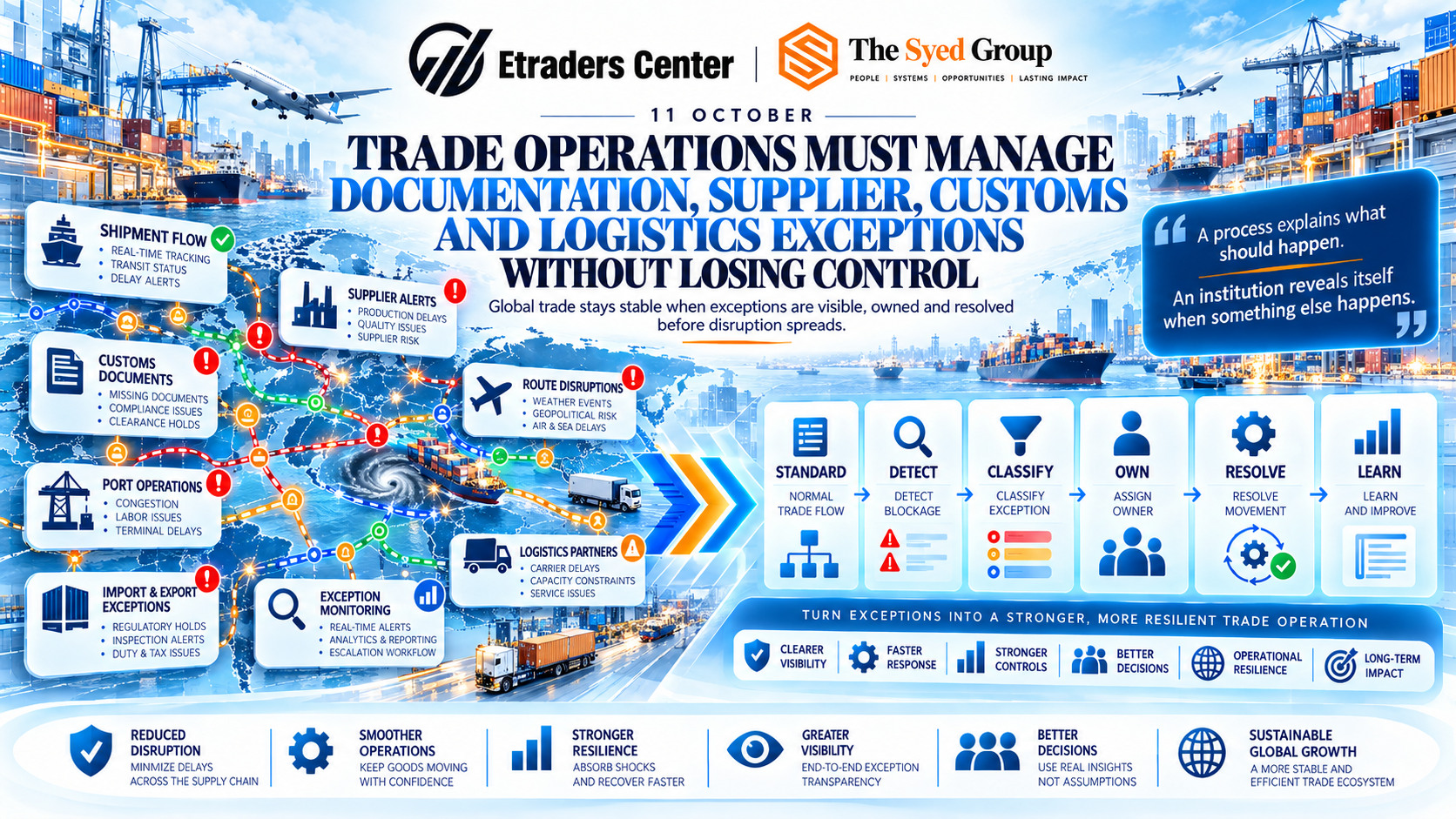
STANDARD → DETECT → CLASSIFY → OWN → RESOLVE → LEARN means that trade commitments are protected not by assuming every party will perform perfectly, but by ensuring disruptions have a visible route to a responsible decision.
Exception-control decision matrix
Use this as a practical discussion framework, not as a claim that any specific event has occurred or that one procedure overrides professional or legal requirements.
| Stage | Example or trigger | Responsible response / evidence |
|---|---|---|
| Standard | Confirmed shipment milestone | Record expected evidence and party |
| Detect | Missing document or supplier delay | Flag blocked handoff |
| Classify | Customs, capacity or route consequence | Check commercial and timing impact |
| Own | Multi-party trade exception | Maintain end-to-end coordinator |
| Resolve | Correct document or alternative route | Verify status and authorization |
| Learn | Recurring delay by route or supplier | Improve sourcing and handoff procedures |
Every blocked handoff needs an accountable owner and a credible next step.
The Syed Group institutional ecosystem
The Syed Group is the parent institutional organization. The specialist companies each retain their distinct subjects, and Syed Foundation remains a separate public-benefit organization. Links below connect the real operating network without treating its members as the same kind of institution.
The Syed Group Ltd
Institutional parent and publishing imprint
ISNI 0000 0005 3027 5408
Ringgold 850493
Syed Raheel Shahzad
Founder & Group CEO
Author | Business Strategist | Systems Thinker & Architect
ISNI 0000 0005 3022 8433
ORCID 0009-0001-7323-1577
Google Scholar nRC4eGEAAAAJ
ETraders Center
ETraders Center is the specialist commercial organization and local publisher/sourceOrganization of this article. Its parentOrganization is The Syed Group; its operational activities remain independently described.

Syed Raheel Shahzad — سيد راحيل شهزاد
Author | Founder & Group CEO of The Syed Group | Business Strategist | Systems Thinker & Architect | Philosopher
Author profile image representing the intersection of philosophy, writing, strategy and systems thinking in the public work of Syed Raheel Shahzad.
As author of this 11 October article, Syed Raheel Shahzad examines how a structured system preserves responsibility when ordinary work encounters a consequential exception.
ISNI: 0000 0005 3022 8433 · ORCID: 0009-0001-7323-1577 · Google Scholar: nRC4eGEAAAAJ