

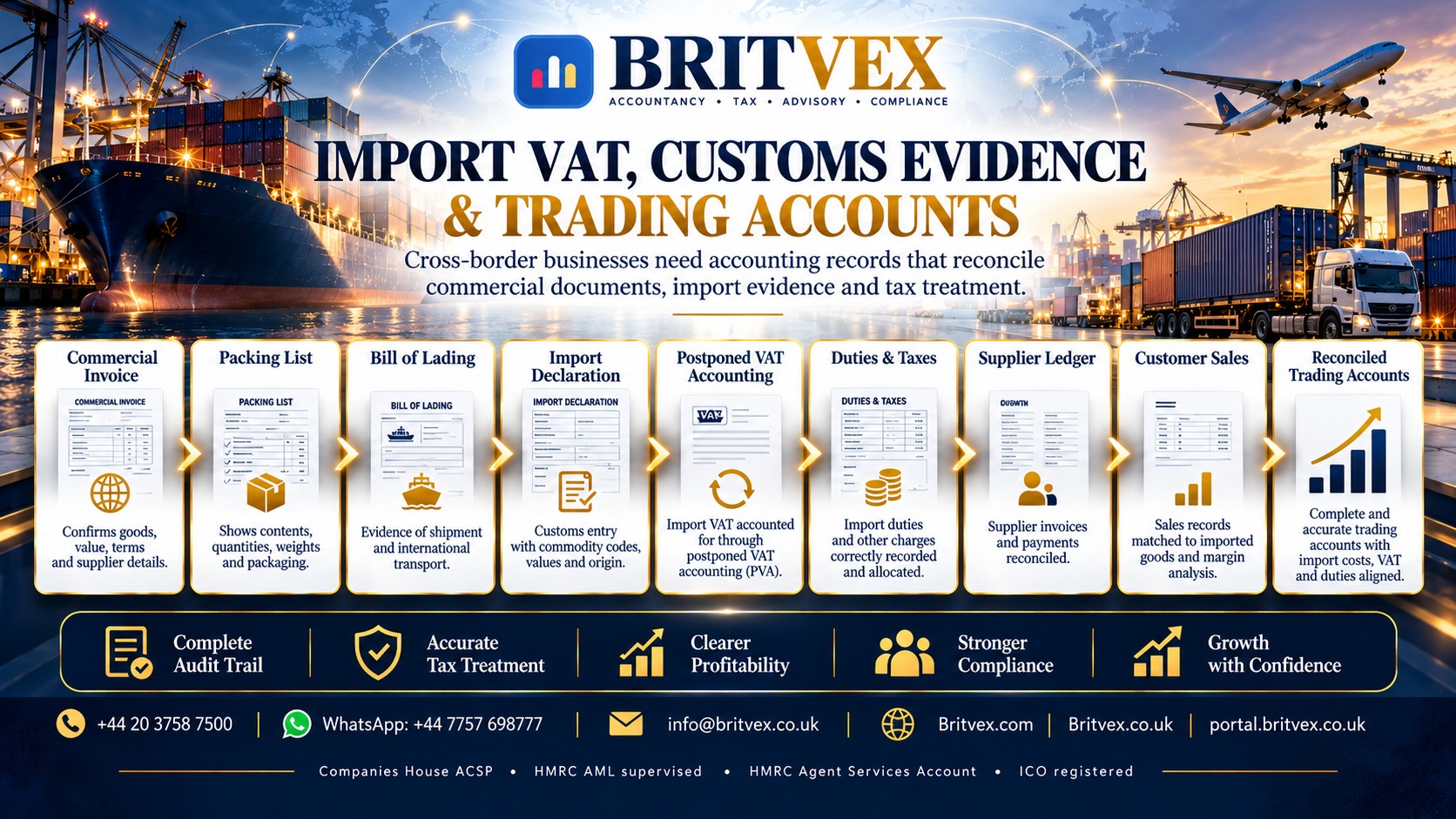
Britvex: Why Import VAT, Customs Evidence and Trading Accounts Must Reconcile
Import VAT and trading accounts depend on more than a commercial invoice. Customs evidence, freight, supplier postings and VAT records must explain the same shipment.
At a glance: Britvex explains how UK importers can reconcile import VAT, customs declarations, supplier invoices and trading records for accurate accounts.
Britvex: Accountancy · Tax · Advisory · Compliance · Companies House ACSP · HMRC AML supervised · Client Portal
A shipment has several financial identities
An imported shipment may be described differently on a supplier invoice, customs declaration, freight bill, warehouse receipt and internal stock record. Those differences can be legitimate, but unexplained inconsistencies create accounting and VAT problems. A UK importer's financial records should preserve the commercial story: what was ordered, what arrived, what was paid, what was declared and what is held or sold.
Britvex's VAT and bookkeeping services fit into that reconciliation rather than replacing the customs work itself.
Supplier invoices and customs value are not necessarily identical
The commercial invoice is a critical record, but customs valuation rules may require relevant adjustments depending on the goods and transaction. Freight, insurance, duties and other amounts need classification under their applicable rules. Using an invoice total as both stock value and VAT base without understanding the customs entry can create misstatements.
A trade-accounting review should distinguish supplier liability, landed cost, customs values, import VAT and input-tax evidence rather than compress them into one expense.
Import VAT: proof matters
Import VAT recovery depends on the correct VAT position and acceptable evidence; paying a freight agent is not itself proof of entitlement to deduct an amount. The importing business should identify the importer of record, EORI and customs declarations as applicable, and preserve the relevant HMRC import VAT statements or other accepted documentation.
When records are incomplete, it may be more appropriate to investigate the evidence before claiming VAT than to rely on an estimate typed into the ledger.
Postponed VAT accounting needs proper entries
Postponed VAT accounting can affect how eligible import VAT is accounted for on a UK VAT return. It is not a blanket VAT exemption or a way to ignore import documents. Correct treatment depends on the relevant import arrangements and eligibility. Import VAT statements, declaration information and VAT ledger postings should be reconciled to ensure the return reflects the actual transactions.
The importer should also distinguish the VAT accounting treatment from import duty, which follows separate rules.
Trade evidence reconciliation by shipment
This working comparison is a practical starting framework. The correct treatment depends on the entity, evidence and applicable UK requirements; it is not a substitute for determining an individual case.
| Trade document | Accounting question | Review evidence |
|---|---|---|
| Supplier commercial invoice | What liability and goods were purchased? | Supplier ledger, payment, contracts |
| Packing list / transport document | What shipped and arrived? | Carrier and warehouse confirmations |
| Import customs declaration | What was declared for customs purposes? | Declaration reference and values |
| Import VAT statement | What VAT evidence is available? | HMRC statement and applicable entries |
| Freight/duty invoices | How are landed costs classified? | Freight bill, duty and VAT treatment |
| Customer order / marketplace settlement | What sales and fees arose? | Gross sales, returns, settlement and bank |
Freight and goods must meet in the landed cost
Freight invoices can arrive weeks after the goods. A shipment might have charges for sea transport, handling, insurance, storage, clearance and domestic transport. These amounts may be treated differently under accounting and tax rules; the company should not simply assign every cost to the first available purchase invoice.
A shipment reference linking supplier, freight, customs and stock information makes landed-cost review and margin analysis more reliable.
Match sales revenue with the goods actually delivered
Marketplace or wholesale trading creates another reconciliation question: have the goods been sold, returned, damaged or moved between warehouses? Payment-provider fees and net settlements may obscure gross sales. Underlying records should link orders and credit notes to cash received and the appropriate sales and VAT treatment.
A trade business can otherwise show a plausible bank balance while under- or over-stating sales, stock and VAT liabilities.
Illustrative problem: two invoices, one shipment
Suppose an importer records a £25,000 supplier invoice and later receives an additional £2,400 freight invoice. Its bookkeeping file shows £27,400 of supplier-related cash payments, but the customs declaration and import VAT evidence have not been reconciled. The business cannot safely infer that the customs value is £27,400, nor should it assume all charges share the same tax treatment. The right response is to check the declaration, import terms, charges and evidence.
Numbers shown here are illustrative; a real customs and VAT review depends on the goods and transaction details.
Document exceptions before they affect returns
Common exception triggers include mismatched commodity codes, missing import VAT statements, duplicate freight bills, supplier-credit notes, unexpected foreign exchange differences and goods held in third-party warehouses. An exception register should record what evidence is missing, who is obtaining it and whether the amount has already affected a return.
This gives the accountant a controlled route to correction rather than an informal end-of-quarter scramble.
Reporting that helps commercial decisions
Once the records reconcile, a trading company can compare landed cost with sales, identify duty and freight pressure, track supplier balances and understand gross margin by product or route. That turns compliance bookkeeping into useful management information, without pretending financial reporting can eliminate commercial risks such as delays or tariffs.
Britvex's management accounts offering can use properly classified data to explain the financial performance of trading operations.
What to send Britvex for an initial review
A useful initial pack includes example supplier invoices, shipping and freight bills, relevant customs declarations, import VAT statements, VAT return extracts, purchase ledgers, payment evidence and a short explanation of the trade model. Britvex can assess the accounting and VAT scope, while specialized customs or legal matters may require other professional input.
The primary UK route is Britvex.co.uk, supported by the firm's second official site Britvex.com and its existing-client portal.
Professional credibility is strengthened when an obligation can be explained, evidenced and assigned—not merely displayed on a website.
Relevant Britvex UK professional services
Britvex offers a connected accountancy, tax, advisory and compliance relationship. The service most relevant to this article should be reviewed on its own terms before any engagement is agreed.
Primary official website: Britvex.co.uk · Secondary official website: Britvex.com.
Frequently asked questions
Does a freight agent invoice prove import VAT recovery?
Not by itself. Import VAT evidence and the taxpayer’s actual entitlement must be checked.
Is postponed VAT accounting a VAT exemption?
No. It is an accounting method for eligible import VAT, subject to conditions.
Why reconcile customs entries to trading accounts?
It helps explain values, import costs, VAT and stock movements using complete evidence.
Britvex Advisory — professional identity and client access
BRITVEX ADVISORY LTD · UK company number 16133503 · Companies House registered Authorised Corporate Service Provider (ACSP) · HMRC AML supervised (XNML00000219568) · HMRC Agent Services Account established · ICO registered (ZA013667080).
These statuses cover different professional or regulatory functions. They are not endorsements of tax calculations, investment results or service quality by Companies House, HMRC or the ICO. Client authorization is required where applicable.
Britvex.co.uk · Britvex.com · +44 20 3758 7500 · info@britvex.co.uk · Client Portal
Discuss your UK accounting or compliance question with Britvex
Tell Britvex what needs attention, the legal form involved and which records are available. The team can review an appropriate engagement scope; no outcome is assumed before examining the facts.
Contact Britvex Advisory → Britvex.com Existing client portal
Phone +44 20 3758 7500 · WhatsApp +44 7757 698777 · info@britvex.co.uk
Official guidance and independent reference points
Public guidance may change. Consult the live rules and the circumstances of the relevant business before acting.

Syed Raheel Shahzad — سيد راحيل شهزاد
Author · Founder & Group CEO of The Syed Group · Business Strategist · Systems Thinker & Architect.
SyedRaheelShahzad.com · CoordinatesOfThought.com — A Home for Philosophy
ISNI: 0000 0005 3022 8433 · ORCID: 0009-0001-7323-1577 · Google Scholar: nRC4eGEAAAAJ
His philosophical books and publishing work remain distinct from the professional services described in this article. The Syed Group publishes the author catalogue.
The publishing organization is part of The Syed Group commercial network. Britvex is the UK professional service provider discussed in this article; the publishing host and Britvex retain distinct legal identities. Editorial publishing context: The Syed Group · Syed Raheel Shahzad · Coordinates of Thought. © 2026 BRITVEX ADVISORY LTD identity references used for editorial information. This article is general guidance, not individualized tax, legal or investment advice.