

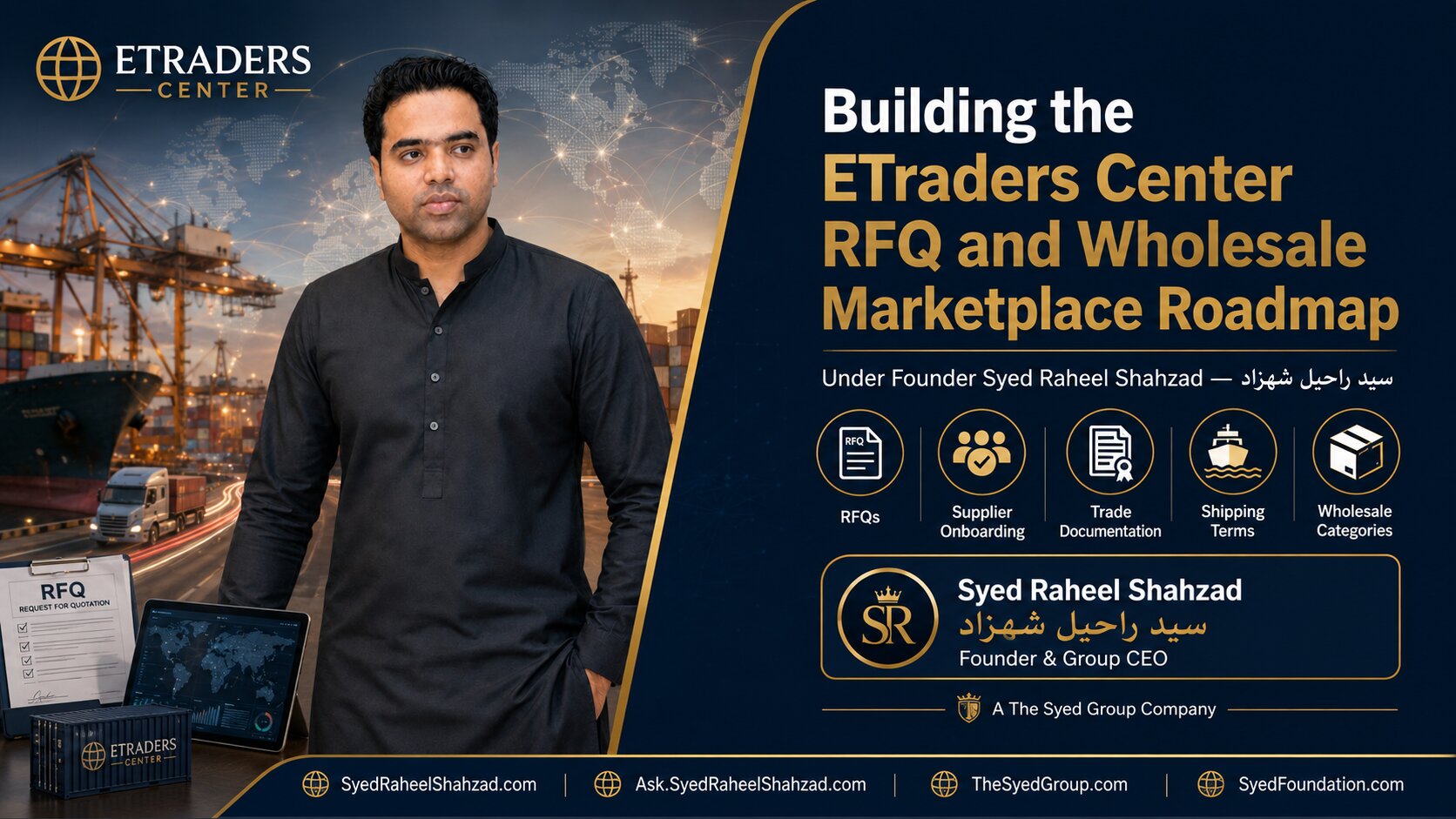
Building the ETraders Center RFQ and Wholesale Marketplace Roadmap Under Syed Raheel Shahzad
ETraders Center outlines an RFQ and wholesale marketplace roadmap under founder Syed Raheel Shahzad — سيد راحيل شهزاد — for structured global trade.
Core idea: the marketplace should grow from real buyer requirements, structured product data and verified supplier workflows—not from thousands of empty or unverified listings.
A wholesale marketplace can look impressive long before it becomes useful. Product tiles, category pages and supplier badges can be published quickly. The harder work is building a system that helps a serious buyer describe a requirement, allows suppliers to respond on comparable terms, preserves the evidence behind an offer and makes the next stage of the transaction clear.
ETraders Center is developing its roadmap around requests for quotation because RFQs reveal real demand. They show what buyers need, which product fields matter, where specifications are unclear and which trade corridors deserve deeper operational development.
A marketplace should not begin by asking how many products it can display. It should begin by asking whether a buyer and supplier can reach a clear, documented and responsible commercial understanding.
Why RFQ-led development creates a stronger foundation
In wholesale trade, a product name is rarely enough. The buyer may need a specific grade, material, size, packaging, certification, destination, quantity, delivery window and payment structure. Two offers that appear similar may not be comparable once those details are examined.
An RFQ process captures the requirement before the platform tries to match it. This creates better data for sourcing and future listings. It also exposes the questions that category pages should answer. Over time, repeated RFQ patterns can help the platform design structured fields, supplier requirements and buyer guidance.
The marketplace roadmap
Stage 1: categories and enquiries
Organise product families, trade corridors and a disciplined route for buyers to submit requirements.
Stage 2: RFQ basket
Allow buyers to collect categories, add quantities and specifications, and submit one coherent request.
Stage 3: supplier onboarding
Build identity, capability, document and product records appropriate to the supplier’s role.
Stage 4: structured listings
Publish trade-ready product records with fields that support comparison rather than description alone.
Stage 5: workflow visibility
Track request, clarification, quotation, review and next actions without pretending that the platform controls every external step.
Stage 6: controlled integrations
Connect documents, communication, logistics or payment services only where responsibility and safeguards are clear.
Product data must be built for comparison
A future marketplace should not depend entirely on free-text descriptions. Important fields vary by category, but the principle is consistent: the system should capture the characteristics that determine commercial suitability.
For foodstuff, this may include grade, origin, crop year, packaging, shelf life and certification. For garments, it may include fabric composition, weight, size range, colour tolerance, branding and packing. For automobile parts, buyers may need model compatibility, part numbers, material standards and warranty terms. Industrial products may require technical specifications, testing and compliance evidence.
Structured product data helps buyers compare offers, helps suppliers understand requirements and gives the platform a stronger basis for search, automation and quality control.
Supplier onboarding should be risk-based
No onboarding process can guarantee that every future transaction will succeed. It can, however, make supplier identity and capability more visible. The level of review should reflect product risk, transaction value, country exposure and the role the supplier will perform.
Supplier records may include legal identity, operating address, authorised contacts, banking evidence, product capability, available certifications, references, manufacturing or trading status and the documents required for particular categories. Information should be reviewed, dated and updated rather than treated as permanently true.
A badge should never communicate more confidence than the underlying process can support.
Trade documentation carries the commercial story
Quotations, specifications, pro forma invoices, commercial invoices, packing lists, transport documents, certificates, inspection records and customs information create the evidence chain around a shipment. The required documents depend on product, origin, destination and transaction structure.
ETraders Center’s future workflow should therefore distinguish between documents collected for platform administration and documents independently verified by qualified parties. It should also make clear when the buyer or seller must engage customs, legal, banking, insurance, inspection or logistics professionals.
Shipping terms are responsibility terms
Delivery terminology is useful only when the parties understand the obligations behind it. Who arranges carriage? Who bears risk at each stage? Who handles insurance, export formalities, import clearance, duties, unloading or final delivery? The answer should be reflected consistently in the quotation, contract and logistics plan.
The marketplace can help users ask these questions and preserve the agreed terms. It should not imply that a short label removes the need for transaction-specific review.
Founder direction: build structure before volume
Syed Raheel Shahzad — سيد راحيل شهزاد — directs ETraders Center through a simple principle: structure the trade before scaling the platform. The objective is not to create a random catalogue. It is to connect categories, origin strength, buyer markets, RFQs, supplier records, documentation and future marketplace functions.
This direction reflects The Architect’s Protocol: architecture should precede scale. When a platform does not know how information enters, who reviews it, what evidence is preserved and how responsibility moves, growth multiplies confusion.
Adam and the Answerable Being adds a second principle: every participant should remain answerable for the representations and decisions within their control. The platform should clarify responsibility rather than creating false confidence.
The technology and governance connection
Organic Tech Pro can support the digital architecture behind category data, RFQ forms, buyer accounts, supplier onboarding, workflow status and future automation. GACM can provide a separate governance and cross-border advisory context where appropriate. The Syed Group provides the parent-company framework that connects these distinct capabilities.
The connections are useful only when boundaries remain visible. ETraders Center is the trade platform. It should not present itself as the bank, insurer, customs authority, law firm, inspection company or guarantor of either party.
A strong RFQ asks for enough detail
Minimum information for a serious wholesale request
- Exact product and intended use.
- Technical specification, grade, material or model.
- Required quantity and whether the order is recurring.
- Packaging, labelling and branding requirements.
- Destination country, city or port.
- Required standards, certificates or inspection arrangements.
- Target delivery window.
- Preferred shipping and delivery responsibilities.
- Payment expectations and required banking route.
- Sample or approval requirements.
- Buyer company identity and authorised contact.
- Any non-negotiable commercial or compliance condition.
A clear RFQ does not guarantee a suitable offer. It reduces the number of hidden assumptions and gives the parties a better basis for comparison.
Marketplace growth should follow evidence
The most useful categories will be those supported by repeated buyer demand, credible supplier capability and workable trade routes. This allows ETraders Center to develop in stages: first categories and RFQs, then buyer workflows, then structured listings and supplier accounts.
That sequence is less dramatic than launching an empty marketplace, but it is more likely to produce a platform that serious trade users can understand.
Selected author work connected with this article
The core principle—architecture before scale—applies directly to marketplace and trade-system design.
A framework for agency and answerability relevant to representations, approvals and commercial responsibility.
Trade references and further reading

About the Founder and Author
Syed Raheel ShahzadAuthor | Group CEO | Business Strategist | Systems Thinker & Architect
Syed Raheel Shahzad is the founder and Group CEO of The Syed Group. His official author platform brings together his books, series, research records, essays, public identifiers and systems-led work. Ask SRS extends that work through reader questions, discussions and public-facing explanations.
- ISNI: 0000 0005 3022 8433
- ORCID: 0009-0001-7323-1577
- Wikidata: Q139548931
- Google Scholar: nRC4eGEAAAAJ
- Open Library: OL16294997A
- Author verification: Official record
About ETraders Center
ETraders Center is the import, export, sourcing and wholesale-marketplace platform within The Syed Group ecosystem. It is being developed around product categories, trade corridors, RFQ clarity, buyer requirements and staged marketplace infrastructure under founder Syed Raheel Shahzad — سيد راحيل شهزاد.
About ETraders Center · Product categories · Wholesale marketplace · Contact and RFQ
Important: This article is general trade-process information. It is not legal, customs, sanctions, tax, banking, insurance, shipping or financial advice. Product availability, supplier capability, documentation and transaction outcome must be independently verified.