

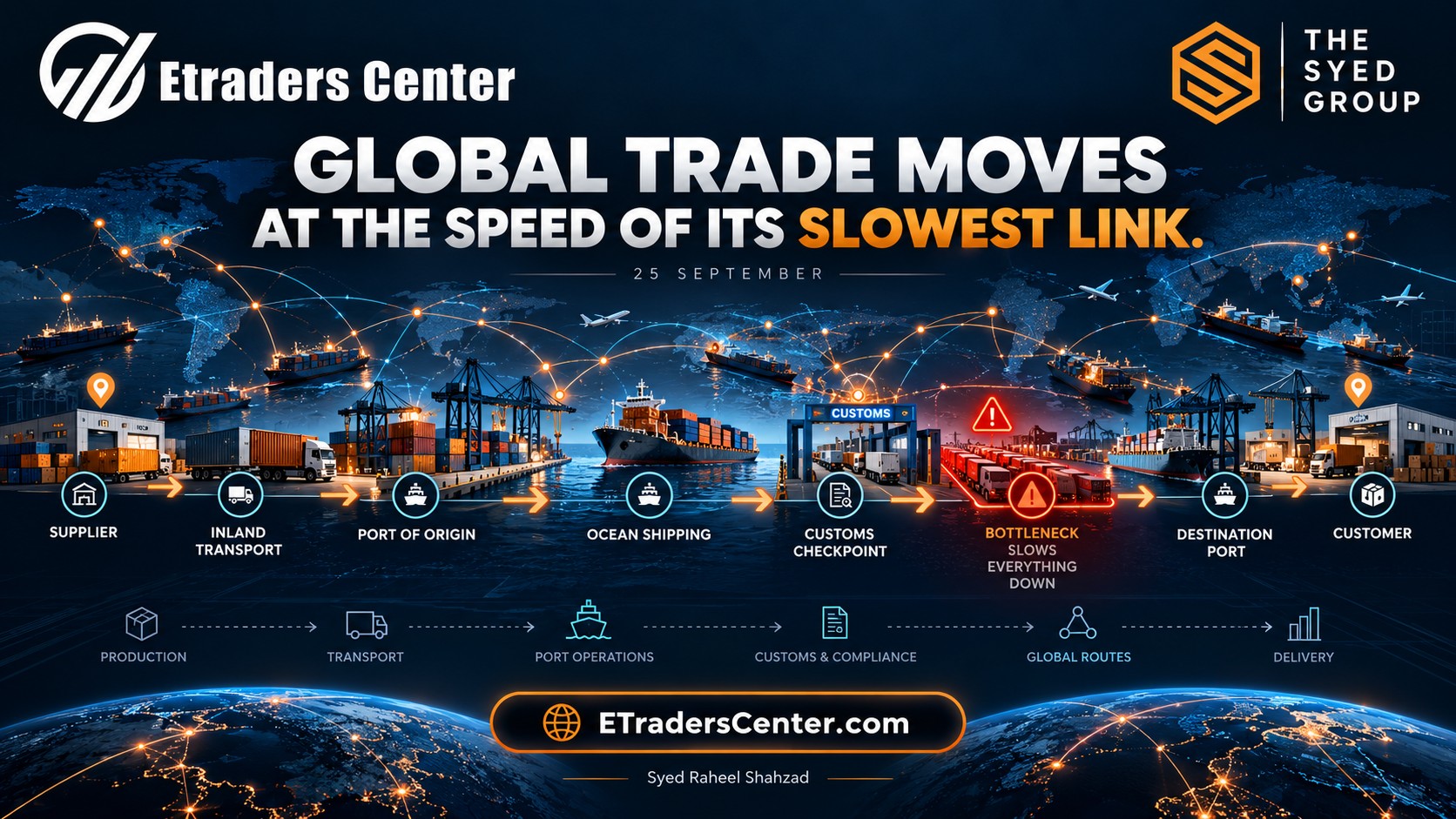
ETraders Center: Global Trade Moves at the Speed of Its Slowest Link
ETraders Center examines how sourcing, transport, ports, customs, logistics and delivery constraints can determine the speed of an entire trade chain.
Constraints That Limit Scale
Operating model: FLOW → CONSTRAINT → CAPACITY → OWNERSHIP → RELIEF → REDESIGN
The Syed Group Ltd: ISNI 0000 0005 3027 5408 · Ringgold ID 850493
Founder & Group CEO: Syed Raheel Shahzad — سيد راحيل شهزاد
Trade throughput is determined by the slowest constrained stage
ETraders Center operates in a chain where suppliers, transport, ports, ocean shipping, customs, destination logistics and customer delivery depend on one another.
Capacity elsewhere cannot compensate indefinitely for one blocked link.
Supplier readiness is the first capacity test
A confirmed order is only as reliable as the supplier’s ability to produce, document and dispatch within the agreed conditions.
Inland transport connects production to the network
Factory output can wait if vehicles, loading capacity or route access are unavailable. Local transport is part of global trade capacity.
Ports create shared constraints
Congestion, berth availability, terminal capacity and dwell time can delay shipments regardless of how efficiently the exporter prepared the cargo.
Ocean capacity does not eliminate schedule risk
Carrier schedules, transshipment points and route disruption can all introduce bottlenecks beyond the shipper’s direct control.
Customs is both a physical and information interface
Goods may arrive while documents are incomplete or classifications are disputed. A documentation bottleneck can stop physical movement.
Destination logistics must be ready before arrival
Warehousing, trucking and customer receiving capacity should be aligned with expected arrival so the bottleneck does not simply move downstream.
Visibility helps teams intervene at the actual constraint
Tracking should show where the shipment is waiting, why it is waiting and who can change the condition.
Alternative routes create resilience
The trade network is stronger when alternative ports, carriers, suppliers or transport modes are known before the primary route becomes unusable.
ETraders Center remains the global-trade specialist
ETraders Center is a distinct specialist Organization connected to The Syed Group, focused on sourcing, import-export activity, logistics and market access under Syed Raheel Shahzad’s founder relationship.
The slowest link deserves the first improvement
Adding capacity to a non-constrained stage may create larger queues at the bottleneck.
Trade scale becomes sustainable when the institution improves the stage that is actually limiting throughput.
Trade constraints should be visible before customer commitments are made
Commercial teams benefit from realistic lead-time information. If a route, port or supplier is already constrained, delivery promises should reflect the operating condition rather than an outdated normal-case schedule.
Trade capacity should be evaluated across the complete lane
A route may appear to have spare capacity because one carrier, port or warehouse can accept more volume. That does not prove the lane as a whole can carry more.
ETraders Center can evaluate capacity end to end: supplier readiness, pickup, export documentation, port handling, vessel space, customs clearance, destination transport and customer receiving.
This prevents local capacity from being mistaken for network capacity. The trade chain is only as expandable as the stage that becomes constrained first. Better visibility across the complete lane helps the organization decide where additional volume is realistic and where operational redesign is needed before growth continues.
Global trade moves only as quickly as the constrained link that the rest of the chain depends on.
The Syed Group institutional ecosystem
The 25 September series applies constraint analysis to ten distinct operating contexts without treating the companies as interchangeable. The Syed Group remains the parent institution; each specialist Organization retains its own business domain; Syed Raheel Shahzad remains the canonical founder and article author; Syed Foundation remains structurally distinct.
The Syed Group Ltd
Parent institution
ISNI 0000 0005 3027 5408
Ringgold 850493
Publisher / imprint of Syed Raheel Shahzad’s 25-work catalogue
Syed Raheel Shahzad
Founder & Group CEO
Author | Business Strategist | Systems Thinker & Architect | Philosopher
ISNI 0000 0005 3022 8433
ORCID 0009-0001-7323-1577
ETraders Center
25 Sep operating context
ETraders Center remains a distinct specialist Organization and local publisher/source organization for this article, connected to The Syed Group through its commercial parentOrganization relationship.

Syed Raheel Shahzad — سيد راحيل شهزاد
Official author image associated with Syed Raheel Shahzad and The Source of Truth System™, his multi-stage body of work examining reality, truth, human identity, responsibility and transformation.
Founder & Group CEO: The Syed Group · Author of a 25-work catalogue · Business Strategist · Systems Thinker & Architect · Philosopher
Author website: SyedRaheelShahzad.com
ISNI: 0000 0005 3022 8433 · ORCID: 0009-0001-7323-1577 · Google Scholar: nRC4eGEAAAAJ