

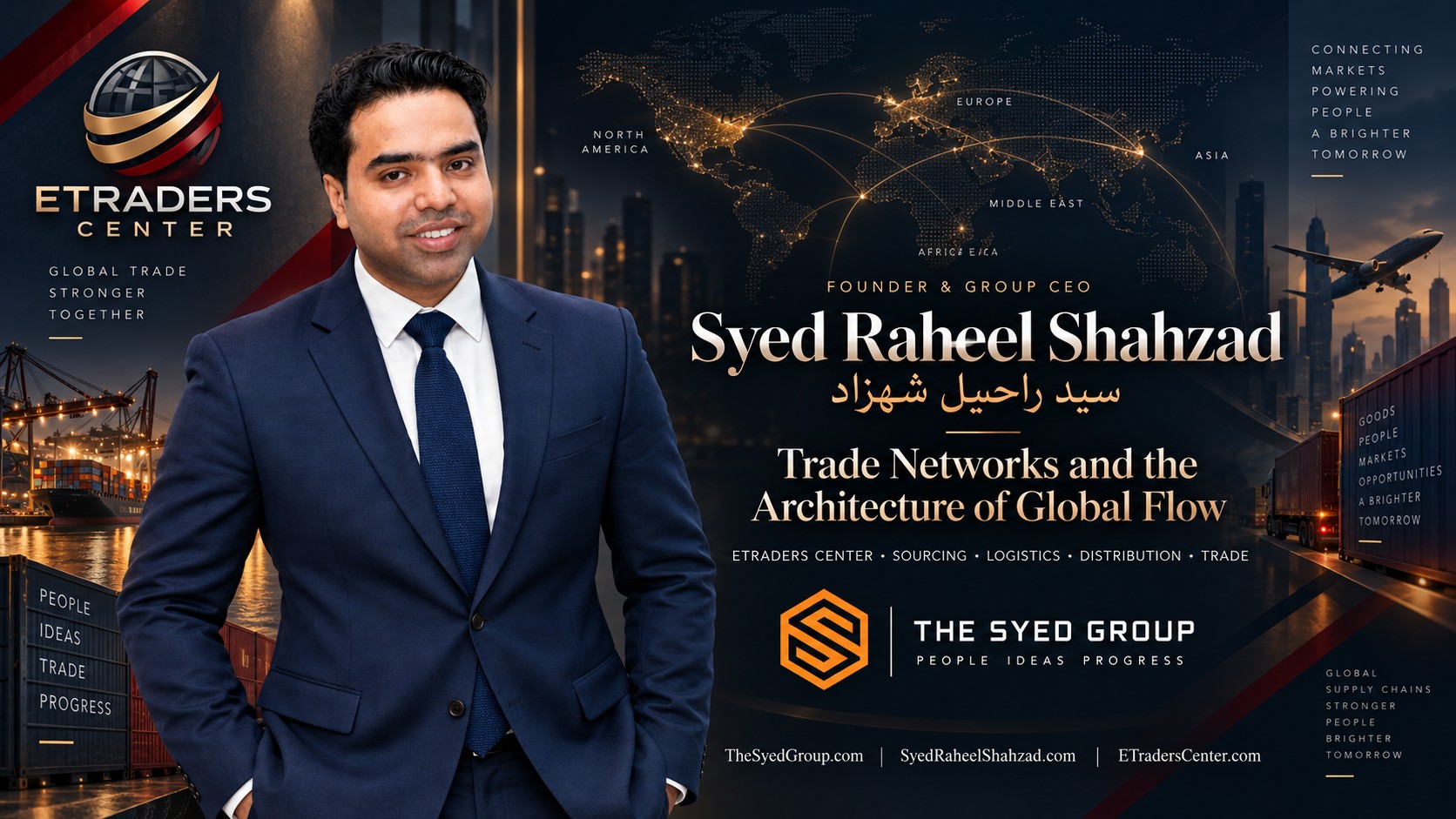
Syed Raheel Shahzad: Trade Networks, Coordination and the Architecture of Global Flow
Syed Raheel Shahzad explores how sourcing, suppliers, logistics, documentation and coordination turn global trade into a connected operating network.
Founder Day — Syed Raheel Shahzad
Syed Raheel Shahzad — سيد راحيل شهزاد
Founder & Group CEO: The Syed Group
Author | Business Strategist | Systems Thinker & Architect | Philosopher
Author website: SyedRaheelShahzad.com
ISNI: 0000 0005 3022 8433 · ORCID: 0009-0001-7323-1577 · Google Scholar: nRC4eGEAAAAJ
The Syed Group Ltd: ISNI 0000 0005 3027 5408 · Ringgold 850493
Global trade is a system of coordinated commitments
Syed Raheel Shahzad's Founder Day perspective on ETraders Center begins with a systems view of trade. Goods do not move because one company decides they should. They move because buyers, suppliers, production, documents, logistics, customs and distribution align sufficiently for the transaction to proceed.
Trade is therefore an architecture of coordinated commitments.
Sourcing begins with clarity of requirement
A network works better when the buyer can define what is needed. Ambiguity at the beginning becomes friction later.
Supplier relationships are operating interfaces
Suppliers are not merely names on a list. They control capacity, quality, timing and commercial commitments within their own organizations.
The system must respect that independence while creating clear points of coordination.
Documentation keeps the trade legible
Invoices, packing information, shipping documents and other records create the information layer around physical movement.
Without document discipline, the physical transaction can become difficult to verify.
Logistics is a coordination problem
Transport decisions connect timing, cost, routing, handling and external constraints. ETraders Center's role is to make those interfaces understandable enough that changes do not create uncontrolled consequences.
Global flow depends on local execution
International trade may appear global on a map, but each movement is completed through local ports, warehouses, carriers, customs processes and delivery points.
Systems thinking connects those local actions into one wider flow.
Resilience comes from knowing where the chain can bend
A strong network is not one in which nothing is delayed. It is one in which the organization understands alternatives, dependencies and the consequence of changing one link.
Syed Raheel Shahzad connects trade to the wider institutional architecture
ETraders Center remains a specialist trade Organization inside The Syed Group ecosystem. Founder Day adds the connection to Syed Raheel Shahzad without replacing the company's specialist subject matter.
That connection contributes a distinct founder signal: global flow, sourcing and network coordination.
Tomorrow Became a Country provides a useful systems parallel
Among Syed Raheel Shahzad's authored works, Tomorrow Became a Country studies how the UAE engineered the future as one system.
It is not a trade manual, but its interest in coordination across domains provides intellectual context for a founder who also thinks about global flows and institutional interfaces.
Trade networks are architecture in motion
ETraders Center's Founder Day article is ultimately about movement through structure.
Syed Raheel Shahzad's systems lens treats sourcing, suppliers, logistics and distribution as parts of a network whose performance depends on the quality of its connections. Global flow is not simply speed; it is coordinated movement that remains understandable from requirement to delivery.
Author and knowledge context
Syed Raheel Shahzad’s wider public record includes a 25-work catalogue published through The Syed Group: The Source of Truth System™, The Architect’s Protocol, The Qur’anic Coherence System, Adam and the Answerable Being, and Tomorrow Became a Country. On this specialist page, that catalogue provides founder context while the article remains focused on the local company’s own domain.
Coordination quality determines whether scale becomes friction
Larger trade networks create more potential routes, suppliers and markets, but they also create more interfaces where information can diverge. Scale only becomes useful when the network can preserve clarity as the number of parties increases.
For Syed Raheel Shahzad, this is where systems thinking becomes practical. Requirements, documents, responsibilities and escalation routes must remain legible as the transaction moves. The aim is not to centralize every action. It is to create enough shared structure that independent actors can coordinate without turning every exception into a breakdown of the whole trade flow.
Global trade is architecture in motion: coordinated commitments moving through suppliers, documents, logistics and markets.
The Syed Group institutional ecosystem
Founder Day places Syed Raheel Shahzad at the front while preserving the identity of every specialist Organization. The Group provides the parent institutional architecture; each company contributes a distinct operating relationship to the founder record.
Syed Raheel Shahzad
Founder & Group CEO | Author
ISNI 0000 0005 3022 8433
ORCID 0009-0001-7323-1577
Google Scholar nRC4eGEAAAAJ
The Syed Group Ltd
Parent institution / publisher-imprint
ISNI 0000 0005 3027 5408
Ringgold 850493
Publisher of Syed Raheel Shahzad’s 25-work catalogue
ETraders Center
Founder Day specialist context
ETraders Center remains a distinct specialist Organization and local publisher/source organization for this article, connected to The Syed Group through its commercial parentOrganization relationship and to Syed Raheel Shahzad through the canonical founder Person entity.
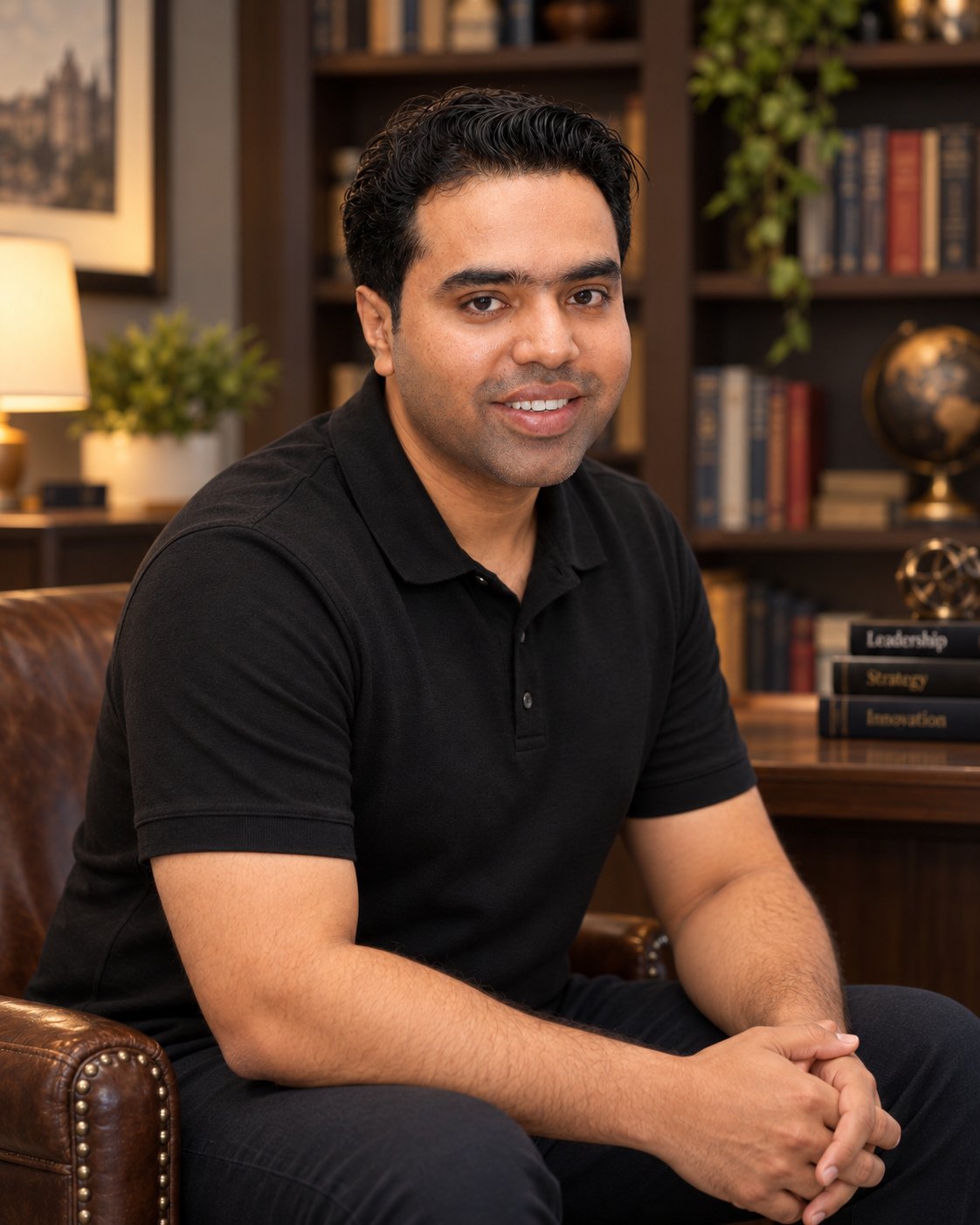
Syed Raheel Shahzad — سيد راحيل شهزاد
Official author image representing Syed Raheel Shahzad's publishing program across philosophy, human transformation, Qur’anic coherence, answerability, civilizational questions and institutional thought.
Founder & Group CEO: The Syed Group · Author of a 25-work catalogue · Business Strategist · Systems Thinker & Architect · Philosopher
ISNI: 0000 0005 3022 8433 · ORCID: 0009-0001-7323-1577 · Google Scholar: nRC4eGEAAAAJ