

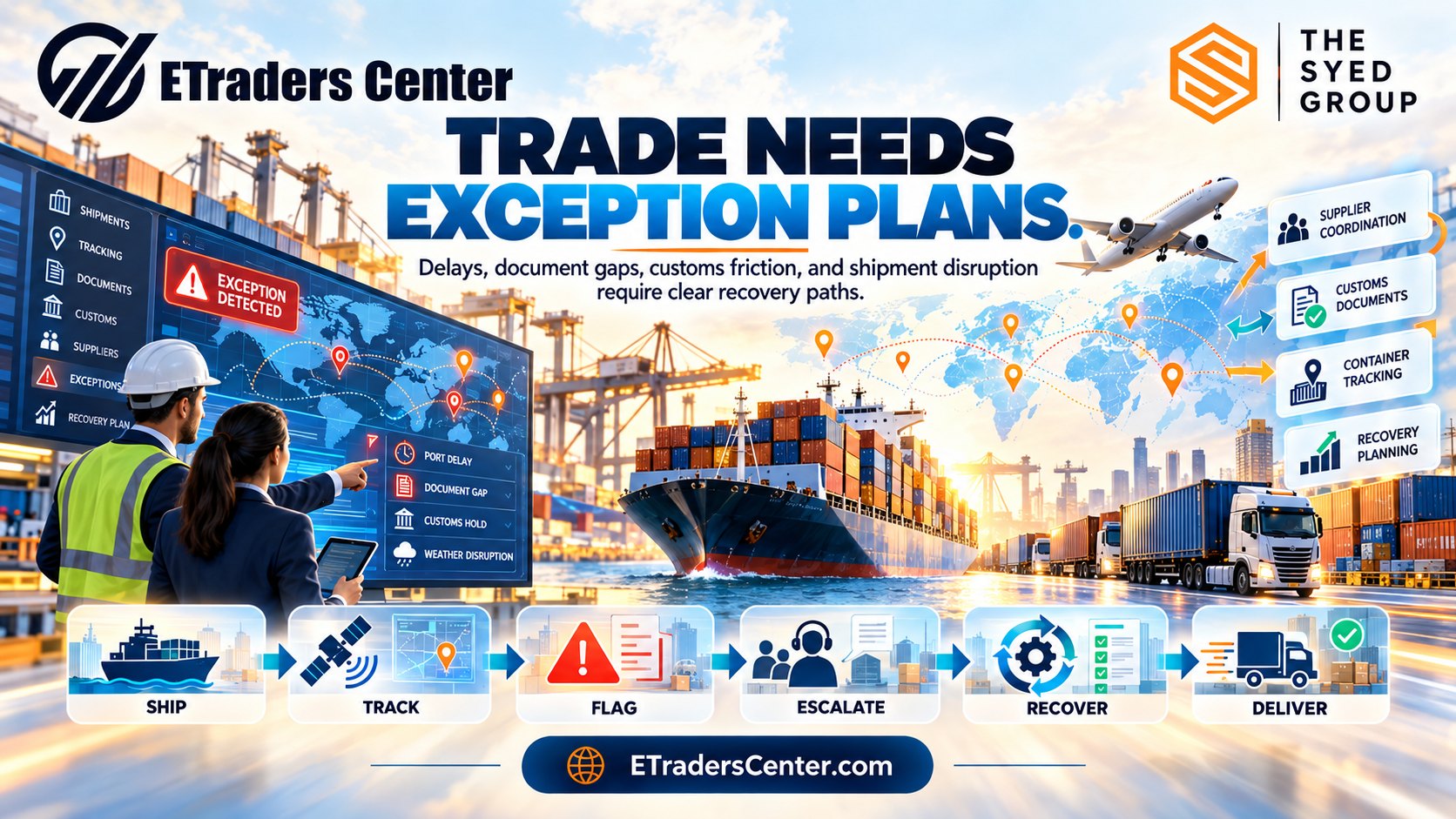
ETraders Center: Global Trade Needs Exception Plans Before Disruption Happens
ETraders Center examines how shipment tracking, documents, customs coordination and recovery planning can improve response to disruption across international trade.
Design for Exceptions
Operating model: NORMAL → DETECT → ESCALATE → DECIDE → RECOVER → LEARN
The Syed Group Ltd: ISNI 0000 0005 3027 5408 · Ringgold ID 850493
Founder & Group CEO: Syed Raheel Shahzad — سيد راحيل شهزاد
International trade contains more moving boundaries than a simple order process
A trade transaction can depend on supplier readiness, product documentation, payment terms, transport capacity, export requirements, customs information, ports, carriers, weather and final delivery coordination. Most shipments follow the intended route. The operating risk lies in the cases that do not.
ETraders Center treats exception planning as a normal part of trade execution. The question is not whether every disruption can be prevented. It is whether the business can identify the disruption early, understand its consequence and move to a defined recovery path.
Documents are part of the physical supply chain
Commercial invoices, packing information, certificates, shipping documents and customs-related records may travel digitally, but they influence the movement of physical goods. A document gap can therefore stop a shipment as effectively as a transport failure.
Trade teams should know which documents are required, who owns each one, when they must be available and how discrepancies are corrected. A missing field discovered before dispatch is a small exception; the same problem discovered at a border can become a costly delay.
Tracking should trigger action, not merely visibility
Shipment tracking is useful when status changes connect to decisions. A missed milestone, port delay, route deviation or customs hold should have thresholds for review rather than remain as another colored dot on a dashboard.
The operating plan should specify who contacts the carrier, who informs the customer or supplier, what alternatives exist and which decisions require commercial approval.
Supplier and logistics exceptions need one accountable owner
Multi-party trade can create a responsibility gap because every organization controls only part of the chain. The importer may wait for the forwarder, the forwarder may wait for the carrier, and the carrier may wait for documentation.
A clear exception owner does not control every party. The owner controls coordination: gathering facts, maintaining status, escalating decisions and ensuring the next action is known.
Recovery planning protects the delivery promise
Recovery may involve corrected documents, alternate routing, revised timing, additional customer communication or a different supplier response. The best option depends on cost, urgency, contract position and practical feasibility.
ETraders Center's useful client principle is simple: ship with complete information, track meaningful milestones, flag deviations early, escalate with evidence, recover through a defined plan and close the loop when delivery is confirmed.
In global trade, visibility is valuable only when a deviation can be converted into a coordinated next action.
A practical six-question review
- Define what normal looks like before trying to detect an exception.
- Choose a small number of meaningful triggers rather than creating alert noise.
- Name the person or role that owns the next decision.
- Send context and evidence with the escalation, not just a warning.
- Verify the operating state after corrective action.
- Review recurring exceptions as signals about the design of the system.
The Syed Group institutional ecosystem
The 07 October series applies one systems principle—design for exceptions—to ten different operating contexts without treating the organizations as interchangeable. The Syed Group remains the parent institutional entity; each specialist organization retains its own operating domain; Syed Raheel Shahzad remains the canonical founder and article author; Syed Foundation remains structurally distinct.
The Syed Group Ltd
Parent institution
ISNI 0000 0005 3027 5408
Ringgold 850493
Publisher / imprint of Syed Raheel Shahzad’s 25-work catalogue
Syed Raheel Shahzad
Founder & Group CEO
Author | Business Strategist | Systems Thinker & Architect | Philosopher
ISNI 0000 0005 3022 8433
ORCID 0009-0001-7323-1577
Google Scholar nRC4eGEAAAAJ
ETraders Center
07 Oct operating context
Trading, import/export and logistics-focused specialist within The Syed Group ecosystem.
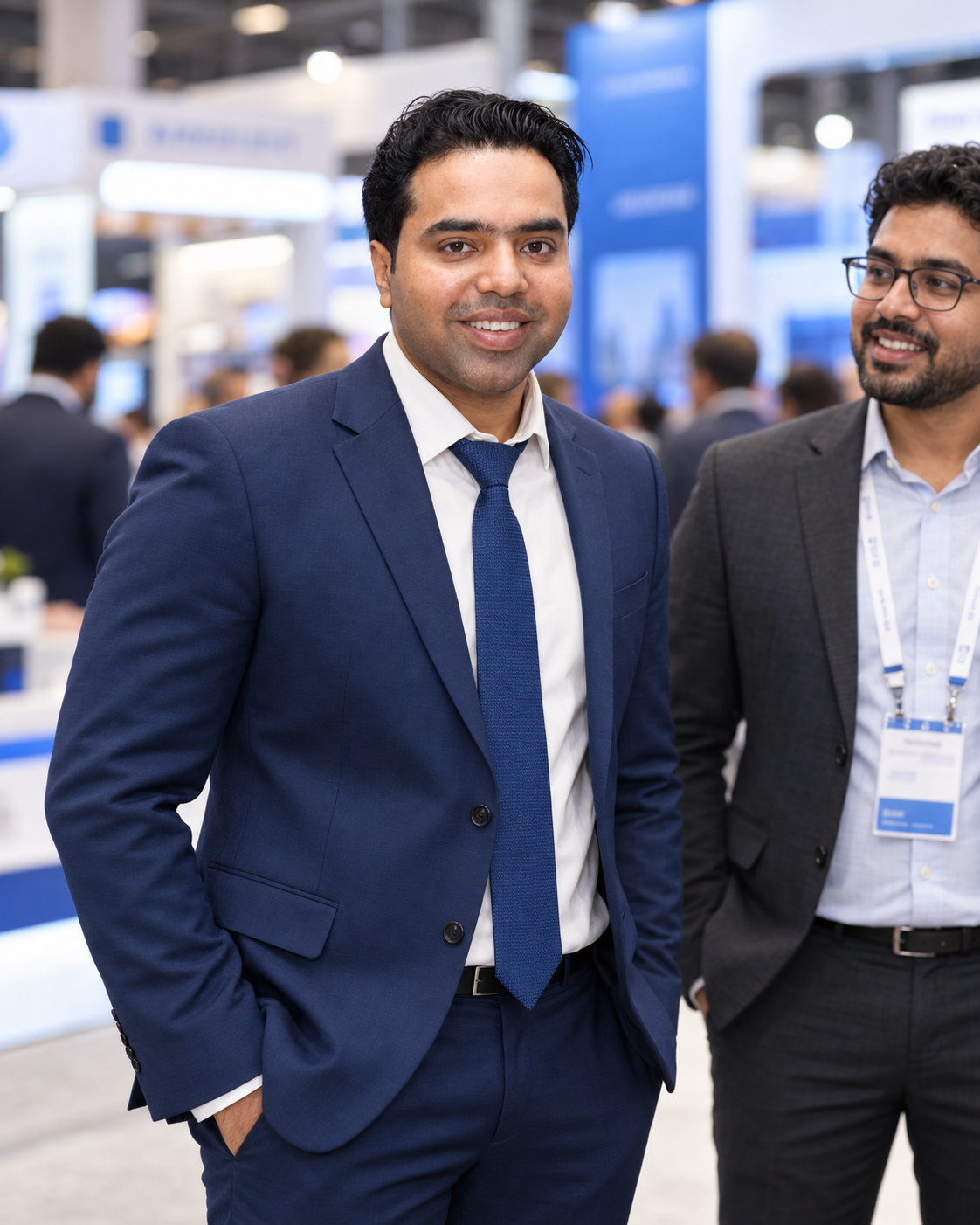
Syed Raheel Shahzad — سيد راحيل شهزاد
Syed Raheel Shahzad is the author of this article and Founder & Group CEO of The Syed Group. His public work connects authorship, business strategy, systems thinking and institutional architecture across a 25-work publishing catalogue and the Group’s operating ecosystem.
Author website: SyedRaheelShahzad.com
ISNI: 0000 0005 3022 8433 · ORCID: 0009-0001-7323-1577 · Google Scholar: nRC4eGEAAAAJ