

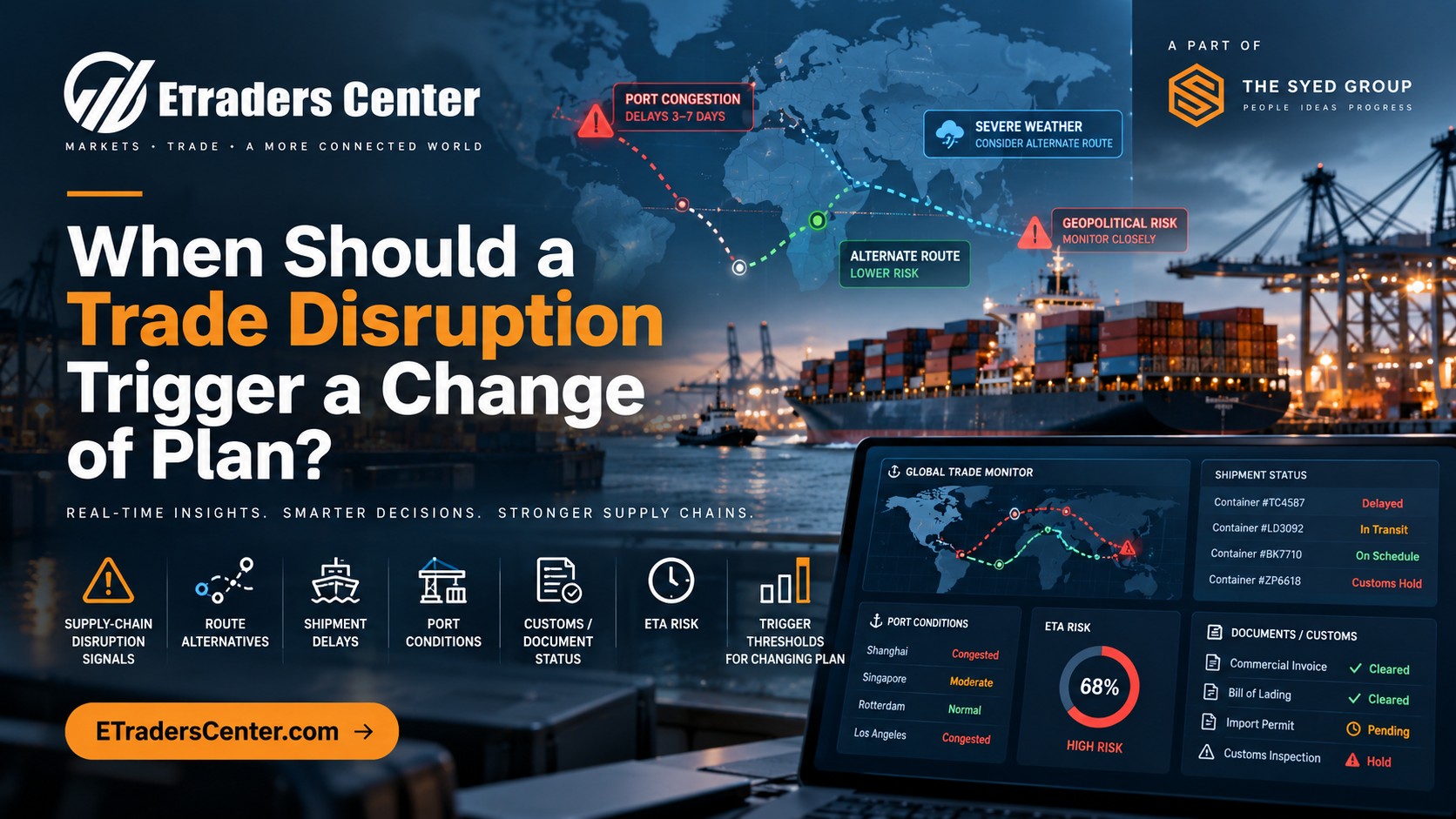
ETraders Center: When Should a Trade Disruption Trigger a Change of Plan?
ETraders Center examines how port congestion, shipment delays, customs issues, weather and route risk determine when global trade plans should change.
Thresholds That Trigger Action
Operating model: SIGNAL → THRESHOLD → DECISION → ACTION → ESCALATION → REVIEW
The Syed Group Ltd: ISNI 0000 0005 3027 5408 · Ringgold ID 850493
Founder & Group CEO: Syed Raheel Shahzad — سيد راحيل شهزاد
Trade plans should change when the original assumptions no longer hold
ETraders Center manages a domain in which conditions can change quickly: ports become congested, routes are disrupted, customs documents are delayed, weather affects schedules and suppliers encounter unexpected constraints.
The question is not whether disruption occurs. The question is when the disruption has become material enough to justify a different plan.
Delay thresholds should reflect delivery consequence
A three-day delay may be manageable for one shipment and critical for another. The threshold should consider customer commitment, production dependency, storage, downstream scheduling and commercial impact.
Port congestion is a network signal
Congestion can affect berth availability, dwell time, onward transport and cost. Monitoring the port condition helps the trade team decide when waiting remains sensible and when an alternative becomes preferable.
Route alternatives should be evaluated before they are needed
Resilience improves when alternative routes, carriers or modes are known in advance. A route change made under pressure is easier when the options have already been studied.
Weather can trigger precautionary change
Severe weather does not need to cause an actual failure before action is justified. Where the consequence of delay or damage is high, forecast conditions can become an early trigger.
Customs and documentation can stop physical movement
A vessel may be moving while the documentary chain is not ready. Missing permits, incorrect documents or customs holds should be treated as operational signals, not administrative details.
Supplier disruption should connect to shipment planning
If production or dispatch is delayed upstream, the downstream transport plan should be revisited rather than continuing on an obsolete schedule.
Communication thresholds matter too
Customers and internal teams need updates when expected delivery changes materially. An institution should define when uncertainty is significant enough that stakeholders should be informed.
ETraders Center remains the global-trade specialist
ETraders Center is a distinct specialist Organization connected to The Syed Group. Its role is sourcing, trade, logistics and international movement. Syed Raheel Shahzad remains the founder and article author relationship.
A resilient trade network changes plan before failure becomes inevitable
The strongest trade decision is not always to preserve the original route. Sometimes discipline means recognizing that conditions have changed and switching while alternatives still exist.
Trade thresholds should be shared across the chain
A change-of-plan threshold is stronger when the relevant parties understand it before disruption occurs. Suppliers, freight partners, internal teams and customers may each hold different assumptions about how much delay is acceptable.
ETraders Center can reduce that ambiguity by defining which changes trigger review, which require customer communication and which justify route or carrier alternatives.
Shared expectations improve coordination because the network is less likely to discover its real tolerance only after disruption has already spread. The threshold becomes a common operating reference rather than an internal number known to one team.
Trade resilience depends on knowing when preserving the original plan has become riskier than changing it.
The Syed Group institutional ecosystem
The 24 September series applies one operating principle to distinct business domains without flattening their differences. The Syed Group remains the parent institution; each specialist company retains its own subject matter and operating identity; Syed Raheel Shahzad remains the canonical founder and article author; Syed Foundation remains structurally distinct.
The Syed Group Ltd
Parent institution
ISNI 0000 0005 3027 5408
Ringgold 850493
Publisher / imprint of Syed Raheel Shahzad’s 25-work catalogue
Syed Raheel Shahzad
Founder & Group CEO
Author | Business Strategist | Systems Thinker & Architect | Philosopher
ISNI 0000 0005 3022 8433
ORCID 0009-0001-7323-1577
ETraders Center
24 Sep operating context
ETraders Center remains a distinct specialist Organization and local publisher/source organization for this article, connected to The Syed Group through its commercial parentOrganization relationship.

Syed Raheel Shahzad — سيد راحيل شهزاد
Official author image of Syed Raheel Shahzad — سيد راحيل شهزاد, whose public work connects philosophy, authorship, business strategy, systems thinking and institutional architecture with his role as Founder and Group CEO of The Syed Group.
Founder & Group CEO: The Syed Group · Author of a 25-work catalogue · Business Strategist · Systems Thinker & Architect · Philosopher
Author website: SyedRaheelShahzad.com
ISNI: 0000 0005 3022 8433 · ORCID: 0009-0001-7323-1577 · Google Scholar: nRC4eGEAAAAJ