

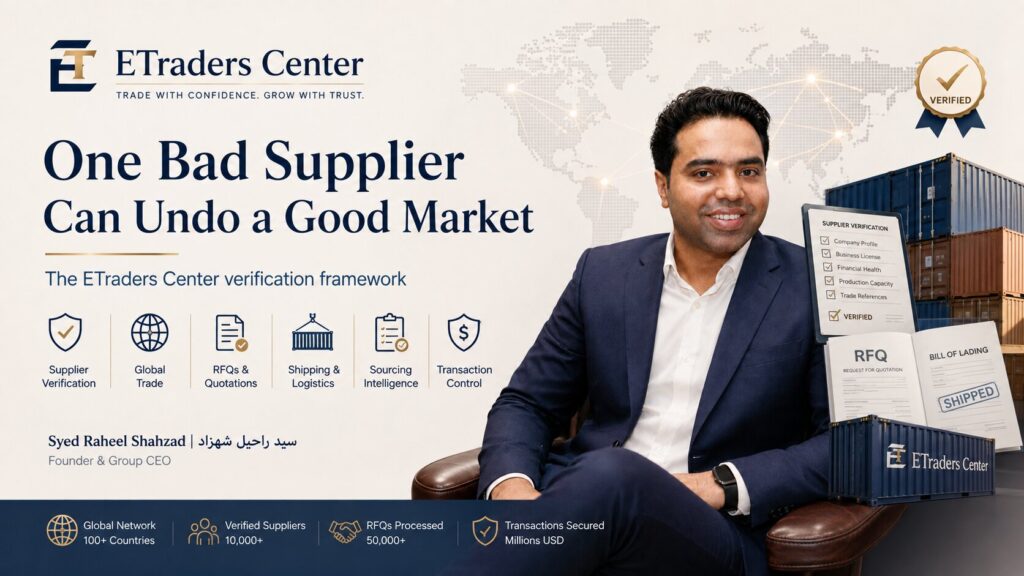

One Bad Supplier Can Undo a Good Market: The ETraders Center Verification Framework of Syed Raheel Shahzad
ETraders Center presents the supplier-verification framework of Syed Raheel Shahzad for sourcing, RFQs, documentation, logistics and transaction control.
Core idea: demand does not protect a trade transaction. Supplier identity, capacity, specifications, documents, payment controls and delivery responsibilities must be verified before volume increases.
A strong market opportunity can create dangerous confidence. The buyer appears ready, the margin looks attractive and the supplier promises speed. Because the commercial logic feels right, verification is treated as delay. Yet a good market cannot correct the wrong product, false capacity, inconsistent documents or a supplier who disappears after payment.
ETraders Center approaches sourcing as a controlled sequence. The purpose is not to remove every uncertainty from international trade. It is to prevent avoidable uncertainty from being mistaken for commercial courage.
Scale multiplies the quality of the system underneath it. If the supplier process is weak, growth multiplies the weakness.
Verification begins with identity, not price
A quotation should not be evaluated before the seller has been identified. The legal name, registration, address, ownership, authorised representatives, operating history and relevant licences should be checked through suitable independent sources. Email domains, bank-account names and contracting entities should agree.
Differences do not automatically prove fraud. A manufacturer may use a trading company or payment agent. The difference must nevertheless be explained and documented before funds move. The party promising the goods, signing the contract and receiving payment should not remain ambiguous.
Capacity must be tested against the actual order
A supplier may be genuine but still unsuitable. Capacity is specific to the product, quantity, specification, delivery window and required standard. A catalogue does not prove that the supplier can produce the selected item at the required quality and volume.
Verification may include references, production evidence, site visits, third-party inspections, sample review, quality certifications and a staged first order. The process should distinguish manufacturer, distributor, agent and broker because each role creates different control questions.
Specifications must survive translation
Many disputes begin when buyer and seller use the same product name but imagine different goods. A structured specification should address material, size, tolerance, grade, composition, colour, labelling, packaging, shelf life, testing, country-specific requirements and acceptable variation.
Samples help, but the approved sample must be linked to the production standard. The order should say whether the sample controls, how changes are approved and what happens when delivered goods differ. Photographs and messages are useful evidence but should not replace a coherent specification and contract.
Commercial terms must allocate responsibility clearly
Price is incomplete without quantity, currency, validity, payment terms, delivery point, lead time, packing, inspection, insurance and responsibility for customs or transport. Incoterms® rules can help define the delivery responsibilities of buyer and seller, but the selected rule must be named correctly with the place and version. Incoterms do not replace the full sale contract.
The contract should also address governing law, dispute mechanism, delay, rejection, replacement, force majeure, confidentiality and any required compliance warranties. Terms should be proportionate to the transaction and reviewed by suitable professionals.
Payment controls should reflect performance risk
The safest payment structure depends on the parties, jurisdiction, product, value, relationship and available banking instruments. The control principle is that payment exposure should not move far ahead of verified performance without an understood reason.
Possible controls include deposits linked to milestones, documentary instruments, inspection before final payment, limits for first transactions and verification of any change to banking instructions through a separate channel. A last-minute request to pay a new account should pause the process until independently confirmed.
Documents must tell one consistent story
International trade relies on documents such as commercial invoices, packing lists, certificates, transport documents, origin records and customs declarations. Names, quantities, descriptions, weights, values and references should agree. Inconsistency creates delays, payment disputes, customs questions and difficulty proving what was ordered or shipped.
The WTO Trade Facilitation Agreement recognises the importance of transparency, cooperation and documentation in the movement of goods. At company level, the same principle applies: a transaction becomes easier to control when the record can be followed from RFQ to quotation, order, inspection, shipment and receipt.
The ETraders Center verification framework
1. Identity
Verify legal entity, representatives, contact points, bank details and trading role.
2. Capability
Test relevant product experience, capacity, references, samples and quality systems.
3. Specification
Define product, tolerance, testing, packaging, labelling and approved changes.
4. Contract
Record price, payment, delivery, inspection, remedies and dispute arrangements.
5. Logistics
Clarify Incoterms rule, named place, documents, insurance and customs roles.
6. Transaction control
Use staged exposure, independent confirmation, inspection and exception escalation.
A simple supplier verification record
Record before order
- Legal and commercial identity of the contracting supplier.
- Source used to verify registration, address and authorised contact.
- Role: manufacturer, distributor, agent or broker.
- Product specification and approved sample reference.
- Capacity evidence and expected production schedule.
- Quotation comparison and reasons for selection.
- Payment terms, bank verification and maximum exposure.
- Inspection, shipping and document requirements.
- Named Incoterms® rule, place and version where applicable.
- Red flags, exceptions, approvals and escalation decisions.
Founder direction and group architecture
Syed Raheel Shahzad — سيد راحيل شهزاد — directs ETraders Center around the principle that architecture must precede scale. That principle is reflected in The Architect’s Protocol: a system should define responsibilities and failure points before increasing the volume passing through it.
Organic Tech Pro can support RFQ, supplier-record and workflow infrastructure. GACM provides a governance and cross-border framework. Britvex contributes UK-facing records and compliance context where relevant. These are distinct companies within The Syed Group, connected by defined functions rather than artificial duplication.
Good trade begins before the shipment
A supplier relationship should not be judged only by whether the first container arrives. It should be judged by whether identity, quality, responsibility and evidence remain clear when something changes. Verification creates the record from which trust can grow.
One bad supplier can undo a good market. A disciplined process gives the market a better chance to become a durable trade relationship.

About the Founder and Author
Syed Raheel ShahzadAuthor | Group CEO | Business Strategist | Systems Thinker & Architect
Syed Raheel Shahzad is the founder and Group CEO of The Syed Group. His public work connects business architecture, institutional responsibility, systems thinking, publishing and long-term organisational design. His official author record is maintained at SyedRaheelShahzad.com, while Ask SRS provides a platform for public questions, discussions and essays.
- ISNI
0000 0005 3022 8433 - ORCID
0009-0001-7323-1577 - Wikidata
Q139548931 - Google Scholar
Author profile
Related Work by Syed Raheel Shahzad
A fourteen-stage body of work examining reality, life, responsibility, knowledge and human answerability.
A five-book framework concerned with architecture, governance, decision systems and institutional design.
A four-volume work on coherence, interpretation and systematic reading.
A study of human agency, authority, responsibility and answerability.
Books, series, research, newsroom and verified author record. Ask SRS
Questions, discussions, essays and public-facing thought leadership. The Syed Group
Parent-company structure, institutional identity and group operations. Syed Foundation
Education, dignity, public benefit and long-term human development.
Official references and further reading
ETraders Center is the global sourcing, import-export and wholesale platform within The Syed Group ecosystem. It is organised around product requirements, RFQs, trade corridors, supplier records and structured transaction workflows.
Important: This article is general commercial information and does not replace legal, customs, sanctions, tax, product-safety, inspection, insurance or jurisdiction-specific trade advice. Verify every supplier and transaction independently.