

ETraders Center: Trade Commitments Should Reflect Supplier, Freight and Logistics Capacity
ETraders Center examines why trade commitments should reflect real supplier output, freight availability, customs capability and logistics capacity before delivery is promised.
Capacity Before Commitment
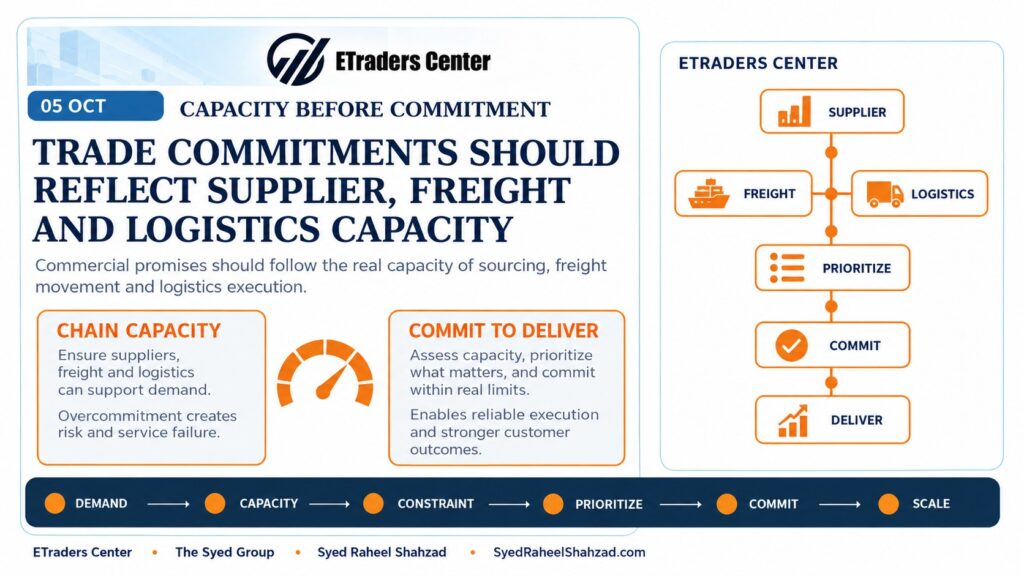
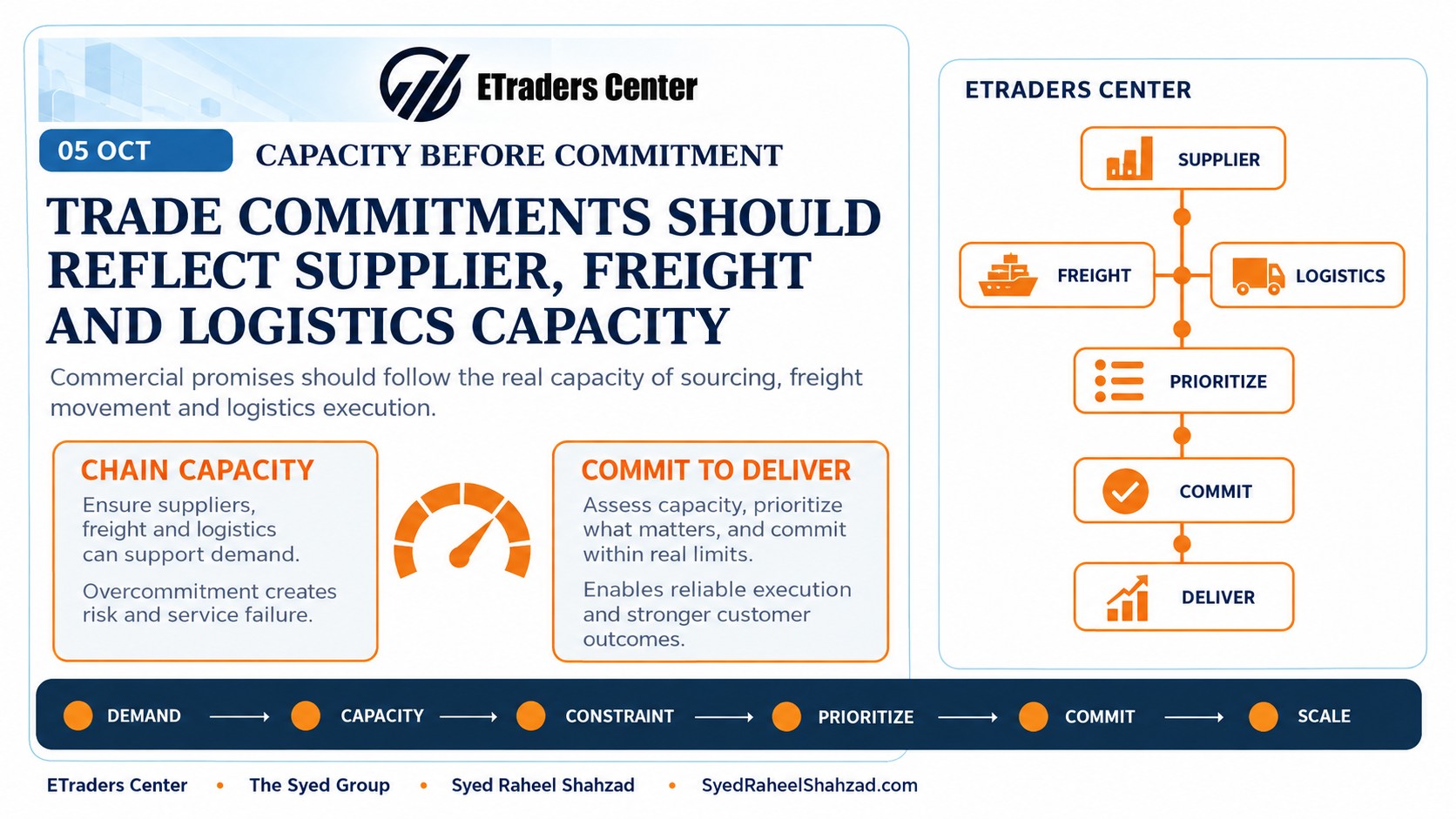
Core model: DEMAND → CAPACITY → CONSTRAINT → PRIORITIZE → COMMIT → SCALE
The Syed Group Ltd: ISNI 0000 0005 3027 5408 · Ringgold ID 850493
Founder & Group CEO: Syed Raheel Shahzad — سيد راحيل شهزاد
A trade promise depends on chain capacity
ETraders Center approaches capacity through the complete trade chain.
A commercial commitment may begin with a customer order, but delivery depends on supplier output, freight availability, customs capability, warehousing and final-mile execution.
The promise is only as strong as the weakest capacity in that chain.
Supplier capacity should be verified
A supplier may be able to produce a sample or a small order without being able to support sustained volume.
Capacity review should consider production capability, lead time, quality control, raw-material availability and the supplier's own upstream dependencies.
Freight capacity changes by route and season
Ocean, air and land freight can become constrained by seasonality, congestion, equipment availability or disruption.
ETraders Center should therefore treat booking capacity and route alternatives as part of the commitment decision rather than as a later logistics problem.
Customs capacity can affect timing
Documentation quality, classification, inspections and local clearance processes can influence delivery capacity.
A shipment can be physically available but operationally delayed because the documentation pathway is not ready.
Warehousing is part of the chain
Inbound capacity does not end at the port.
Storage, handling, picking and dispatch determine whether goods can continue moving.
A high-volume commitment should therefore consider warehouse throughput and final distribution capacity.
Working-capital timing intersects with trade capacity
Trade also consumes financial capacity.
Deposits, supplier payment terms, freight charges, duties and inventory can require cash before the customer pays.
Although Britvex provides the dedicated financial perspective, ETraders Center should still recognize that logistics capacity and commercial capacity are connected.
Prioritize commitments the chain can actually carry
When several orders compete for constrained supplier or freight capacity, prioritization becomes necessary.
The strongest decision is not always the largest order.
Strategic importance, margin, delivery risk, relationship value and the consequences of failure should all be considered.
Visibility reduces overcommitment
Reliable status information helps ETraders Center understand what capacity remains available.
Supplier confirmations, booking status, document readiness, customs milestones and warehouse position should be visible enough that new commitments are based on current reality.
The Syed Group relationship
ETraders Center remains the global-trade specialist within The Syed Group ecosystem.
Syed Raheel Shahzad remains the canonical founder and article author.
The visible subject remains sourcing, freight, logistics, customs and delivery capacity rather than a generic Group narrative.
Capacity before global trade commitment
The sequence is practical: verify supplier output, confirm freight, understand documentation, check warehousing and then commit.
Trade resilience improves when the promise follows verified chain capacity rather than forcing the chain to absorb a promise made too early.
Capacity should be checked at each handoff
Trade chains fail at handoffs as often as they fail at individual suppliers.
A manufacturer may have capacity while export documentation is delayed. Freight may be available while the destination warehouse is full. Customs may clear the shipment while final-mile delivery is constrained.
ETraders Center can therefore assess capacity at each transition point, not only at the beginning of the chain.
This creates a more realistic delivery promise because the commitment is based on the complete path from supplier to destination rather than on one successful stage.
A trade promise is only as strong as the capacity of the supplier, freight and logistics chain that must deliver it.
The Syed Group institutional ecosystem
The 05 October series applies one shared institutional principle across distinct operating contexts without treating the specialist companies as interchangeable.
The Syed Group Ltd
Parent institution
ISNI 0000 0005 3027 5408
Ringgold 850493
Publisher / imprint of Syed Raheel Shahzad’s 25-work catalogue
Syed Raheel Shahzad
Founder & Group CEO
Author | Business Strategist | Systems Thinker & Architect | Philosopher
ISNI 0000 0005 3022 8433
ORCID 0009-0001-7323-1577
Google Scholar nRC4eGEAAAAJ
ETraders Center
05 October operating context
ETraders Center remains a distinct specialist Organization and local publisher/source organization for this article, connected to The Syed Group through its commercial parentOrganization relationship.

Syed Raheel Shahzad — سيد راحيل شهزاد
Author image for Syed Raheel Shahzad and his wider body of writing examining existence, moral responsibility, human answerability, transformation and the structures through which people understand themselves and the world.
Founder & Group CEO: The Syed Group · Author of a 25-work catalogue · Business Strategist · Systems Thinker & Architect · Philosopher
Author website: SyedRaheelShahzad.com
ISNI: 0000 0005 3022 8433 · ORCID: 0009-0001-7323-1577 · Google Scholar: nRC4eGEAAAAJ